
Roots of Hate: Fascist and fundamentalist narratives & actors in South Asia and Southeast Asia regions (Noor, 2024)
In this mapping, we see fascist and fundamentalist narratives act as iterations that harness economic crises, neoliberal policies and social fractures to cement their fascist and fundamentalist power. Militarism, as it manifests across SSEA, is not only the overt presence of armed forces but a pervasive ideology that infiltrates every facet of life, intertwining with national identity and economic survival. It transforms the state into a perpetual war machine, justifying its existence through the continuous production of enemies, both within and beyond its borders.
This militarized logic and narrative extend into the civilian sphere, where the lines between governance and warfare blur, turning populations into both subjects of control and instruments of violence, all in service of maintaining a homogenized, compliant society. At the same time, we see digital fascism operating as the algorithmic extension of state power and the invisible hand that shapes state narratives, turning data into weapons of social control, and making the machinery of repression both flexible and invasive.
The machine that fosters shame: The weaponisation of sexuality in anti-gender anti-democracy disinformation (Association for Progressive Communications – APC – 2024)
There exists a growing body of mainstream journalistic and scholarly work about
disinformation which attempts to capture and expose the bounds of a “disinformation
industry”, or “disinformation for hire”. In addition, there is a large body of data-based work
which looks at disinformation as “computational propaganda” wielded by nation-states. Much of this work uncovers the involvement of “foreign powers”, and the use of bots and trolls.
The public conversation about disinformation tends, therefore, to be framed using a “macro” lens, with concern for its “serious” impact on political and democratic processes. On the other hand, the impact of disinformation campaigns which weaponise sexuality and target communities who are excluded due to gender, sex and sexuality norms, are seen as having a “less serious” effect on politics and democracy, even though the evidence
says otherwise.
Despite these conditions, there is an increasing focus on “gendered disinformation”,
including from international human rights experts, like the UN Special Rapporteur on
freedom of expression (UNSR FoE).
Our aim with this paper is to explore the specific location of sexuality in disinformation campaigns targeting those standing up to patriarchal and authoritarian regimes of social and political power, going beyond “gender”.

Visual Politics and Feminist Strategies in Sri Lanka: Insights from three landmark cases (The South Asia Trust, 2023)
Co-author: Shermal Wijewardene
This essay foregrounds the significance of visual and discursive protest strategies in feminist campaigns against sexual and gender-based violence in Sri Lanka. Visual imagery has been ubiquitous in the mode by which some Sri Lankan women’s organisations and individual activists have tried to influence public opinion on the subject. There have been recent efforts to curate, publicly exhibit and preserve visual campaign material analog and digital forms. Despite this prominence, there is a dearth of research on how visual modes have historically been used by feminist activists or by women’s groups in Sri Lanka.
This essay is part of a series titled, ‘Challenging Visual Depiction of Women and Sexual Violence in Southasia’ published by The Southasia Trust. The image accompanying the blurb was taken from Historical Dialogue LK, and is credited to the Sunday Times (Sri Lanka).

Queerness, Sex Work, and Refugee Status in Nairobi: A conversation with Queer Sex Workers Initiative for Refugees (Anti-Trafficking Review No. 19 (2022): Special Issue – Migration, Sexuality, and Gender Identity)
In this interview, the author speaks with Queer Sex Workers Initiative for Refugees: a Nairobi-based grassroots service-provision and advocacy group formed by queer refugees in Kenya who are engaged in sex work. The interview explores the question of how queer identity experiences interact with the policing of borders, labour issues, and refugee status. It teases out the ramifications of the compounding factors of migration and criminalisation of sex work and gender diversity, across borders, to show how these produce discrimination, loss of livelihood, and vulnerability to violence.

Porn, sexuality and expression in Sri Lanka: feminist debates and interventions (Porn Studies Volume 9, 2022 – Issue 3: South Asian Pornographies)
This article explores the engagement of feminists in Sri Lanka with the question of pornography. The article looks at some of the ways in which feminist scholars in Sri Lanka have written about sexuality, sex work and freedom of expression, as a way of engaging with the gaps and nuances in Lankan feminist discourse and debate, if any, about pornography. The article explores how state prohibition and social stigma about sexuality inform the conditions within which expressions of sexuality and the production and dissemination of erotic material takes place in Sri Lanka, and how, at times, feminist and/or women’s rights interventions themselves support or impede the process.
Co-authors: Kimaya de Silva, Cayathri Divakalala and Hasanah Cegu Issaden
In Sri Lanka, abortion continues to be a criminal offence under the Penal Code of 1883. Several attempts have been made to challenge the colonial-era law since the 1990s with no success thus far. This study documents and centres the knowledge of women and transpersons in accessing abortion and sexual health and reproductive health services in Sri Lanka in order to contribute to the conversation on abortion law reform as well as research and advocacy. Our data suggest that the existing legal reforms proposed to the abortion law would be unresponsive to the needs of women and transpersons in Sri Lanka, and that in additional to legal changes, we would need significant social and cultural changes. This study uses feminist research methodologies, building towards a feminist ethics in abortion research.
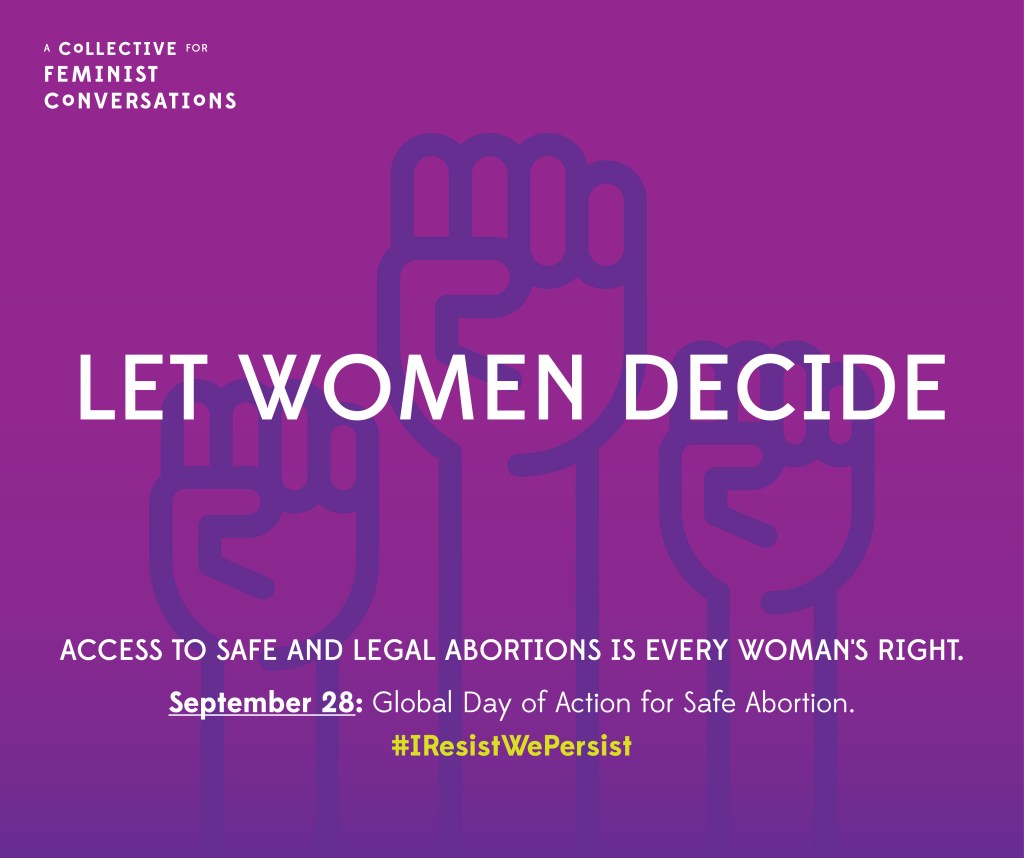
The image accompanying the blurb was designed by Thilini Perera for a campaign produced by A Collective for Feminist Conversations in Sri Lanka, 2017.
Not Traditionally Technical: Lesbian women and their use of the online space (Association for Progressive Communications, 2017)
Co author: Shermal Wijewardene
The objective of this section of the study is to offer a “thick” account of how lesbian women engage
with the online space. The rationale for devoting
a separate section to this arose from the data. As
one-on-one interviews and a focus group discussion
showed, lesbian women’s online engagements demanded to be treated as specifically gendered and sexualised experiences, while being classed, race-based and so on. Their approach to the online space was traced through with the awareness that they had to negotiate being hailed by a patriarchal and heterosexist social system. We felt that this understanding called for a dedicated analysis.
This essay was published as the second chapter of a study on LGBTIQ people and their use of the online space in Sri Lanka, titled “Virtually Queer”, commissioned under APC’s EROTICS research, as part of a wider study of South Asia. The image was taken from APC’s website.
 Subha M Wijesiriwardena